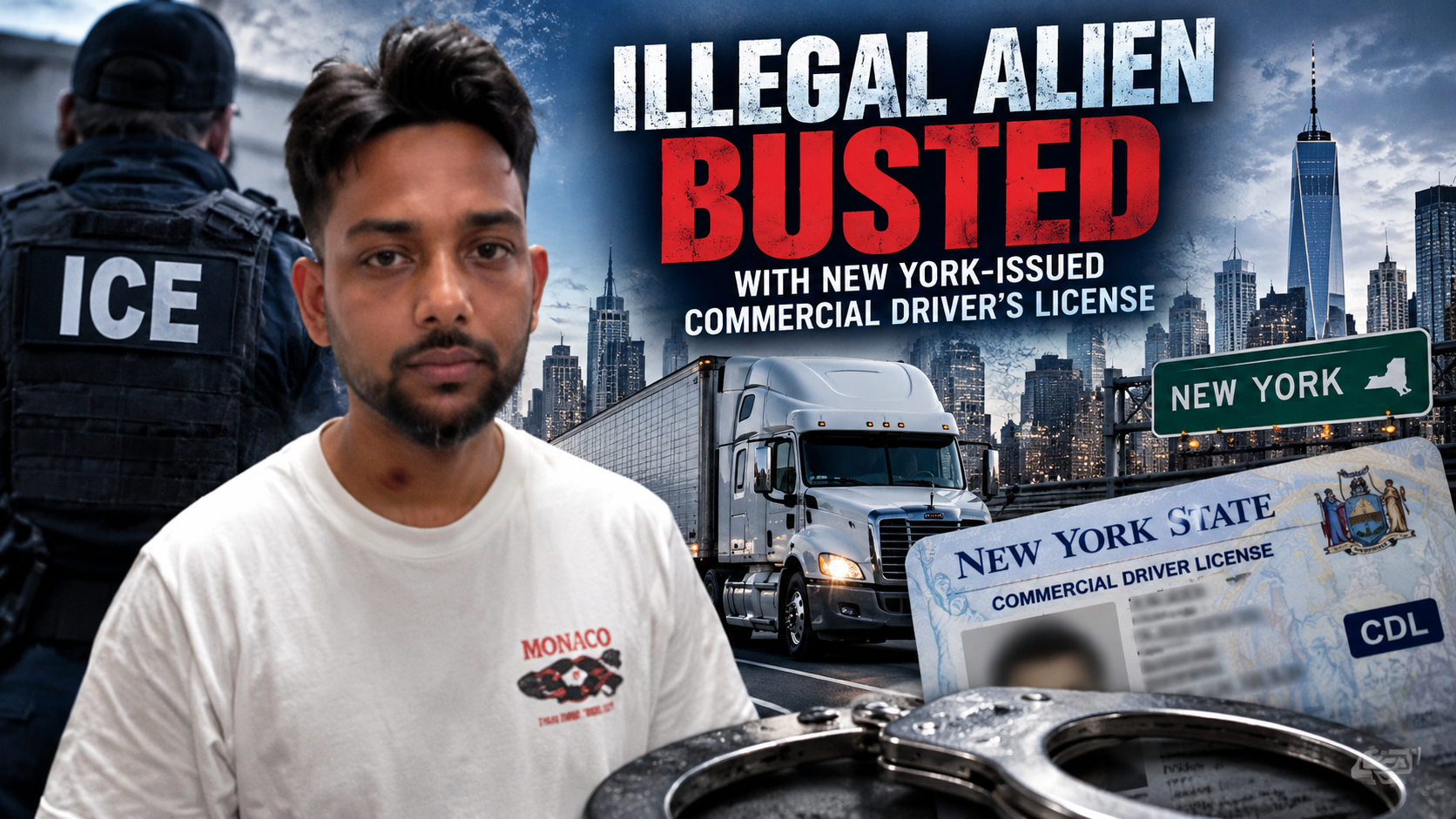
ICE picked up Simranpal Singh at a truck scale in Newberry, Pennsylvania, on September 4. He had a New York commercial driver’s license, an active wire fraud warrant, and no legal right to be in the country. He’s the latest in a pattern the federal government is now calling a system failure.
On September 4, 2026, an ICE officer with Enforcement and Removal Operations Philadelphia was working a routine commercial vehicle inspection at a weigh station in Newberry, Pennsylvania. The officer was conducting inspections of commercial vehicles when a driver presented his CDL for inspection, and the officer determined that the driver, Simranpal Singh, was an illegal alien from India and took him into custody. That weigh station stop is not supposed to be an immigration checkpoint. It’s a safety stop: weights, hours, logs, condition of the equipment. Instead, it turned out to be a man with no legal right to be in the country driving a commercial vehicle, and a federal warrant behind his name.
At the time of his arrest, Singh had an outstanding warrant for wire fraud and wire fraud conspiracy out of the Middle District of Pennsylvania. Singh had illegally entered the United States through Arizona in June 2022, was arrested by U.S. Border Patrol, and was subsequently released into the country by the Biden Administration. He then made his way to New York, obtained a commercial driver’s license from the state, and was operating a commercial vehicle across state lines with an open federal warrant until a scale officer in a rural Pennsylvania county asked to see his paperwork. Upon completion of the criminal case, ICE will resume custody and he will be given due process through pending removal proceedings. Singh is presumed innocent of the wire fraud and wire fraud conspiracy charges until proven guilty in court.
The story is that it keeps happening, and it keeps happening with New York licenses.
In March 2026, ICE arrested Sukhdev Singh, an illegal alien from India, after he allegedly caused a crash while driving a semi-truck that left a U.S. citizen hospitalized in critical condition in Indianapolis, Indiana — a driver who had been given a CDL by New York. On March 6, 2026, at approximately 6:30 p.m. EST, Singh hit a pedestrian at E Raymond Street and I-65 in Indianapolis. All charges against Sukhdev Singh are allegations; he hasn’t been convicted of any offense related to that crash. In October 2025, Anmol Anmol, an illegal alien from India, had been granted a CDL by New York with the name “No Name Given Anmol” and was arrested by ICE. New York and federal officials disputed how that name appeared on the credential, but the credential was real and it cleared a man with no lawful status to operate an 80,000-pound commercial vehicle across the country.
New York’s position on standard driver’s licenses is well established. The right comes from New York’s Green Light Law, formally known as the Driver’s License Access and Privacy Act, passed in 2019. That law “allows all New Yorkers age 16 and older to apply for a standard, not-for-federal purpose, non-commercial driver license or learner permit regardless of their citizenship or lawful status in the United States,” according to the DMV website. A standard license and a CDL are different credentials. The Green Light Law does not apply to illegal immigrants seeking a commercial driver’s license. Federal authorities are now asking how individuals without lawful status ended up with CDLs anyway, and how many more are out there.
A CDL isn’t a license to drive a car. It’s a federal credential, governed by 49 C.F.R. Part 383, that authorizes the holder to operate a vehicle with a gross vehicle weight rating over 26,001 pounds, to haul hazardous materials, and to drive passenger-carrying vehicles above certain thresholds. The states issue the physical document, but the standards are federal. The knowledge tests, the skills tests, the medical certification, the background verification — those are all supposed to happen before the card is printed. What the cases coming out of New York, California, Pennsylvania, and Massachusetts suggest is that somewhere in that process, the immigration status check either didn’t happen or didn’t produce the right result.
The administration has launched Operation Highway Shield, a joint operation targeting unqualified commercial drivers on U.S. highways. On September 9, ICE’s Homeland Security Investigations announced an official tipline for reporting fraud involving commercial driver’s licenses. The tipline number is 866-347-2423. Five days after that announcement, DHS published the Simranpal Singh arrest. That sequencing isn’t coincidental. DHS is building a public record, case by case, that the CDL credentialing system has a gap that states are either unable or unwilling to close.
The federal legislative answer, so far, is H.R. 5688, called the Dalilah Law. If enacted, the Dalilah Law would bar states from granting CDLs to undocumented immigrants. As of March 18, 2026, the bill had passed the House Transportation and Infrastructure Committee. It hasn’t become law. In the meantime, the state-level CDL process remains the same, and cases keep coming.
New York’s Green Light Law has survived a federal legal challenge. The Justice Department filed a lawsuit in February against Governor Kathy Hochul and Attorney General Letitia James, arguing that the law prioritizes undocumented immigrants over U.S. citizens. In a 23-page ruling, U.S. District Judge Anne Nardacci found that the Justice Department failed to show the law conflicts with the Constitution’s supremacy clause. The law stands. The law also includes privacy provisions requiring the state Department of Motor Vehicles to notify individuals when federal immigration agencies request their information, which federal enforcement officials have argued complicates both warrant checks and roadside officer safety. Those provisions survived the ruling too.
The pattern DHS is cataloging now extends beyond New York. Michael Bon, an illegal alien from Haiti, caused a semi-truck crash that killed a Pennsylvania State Trooper in July 2026; he had been granted a CDL by Massachusetts. Bekzhan Beishekeev, an illegal alien from Kyrgyzstan, swerved into oncoming traffic and caused a head-on collision that killed four people in Indiana in February 2026 he had been granted a CDL by Pennsylvania. Harjinder Singh, accused of causing an August 2025 crash in Fort Pierce, Florida, that killed three people, failed his CDL knowledge test 10 times in two months before finally receiving a license in Washington state; investigators learned he failed the knowledge exam between March 10, 2023, and May 5, 2023. All charges and allegations in those cases remain unproven in court. But the credential that put each of those drivers on the road with federal authorization was real, and the states that issued it did so under processes that apparently didn’t catch the applicant’s immigration status.
The mechanism that’s supposed to prevent this is the Commercial Driver’s License Information System, or CDLIS, a federal database administered by FMCSA under 49 C.F.R. Part 384. Every CDL applicant should be verified against it to prevent duplicate licenses. The system wasn’t designed for immigration verification. It checks whether you already have a CDL somewhere else. It doesn’t check whether you’re lawfully authorized to work in the United States or whether a federal warrant is sitting in the NCIC behind your name. Those are separate systems, and the question no one has answered publicly is why the state-level CDL application process isn’t running the applicant against both before issuing the credential.
If you’re a carrier or a broker who tendered a load to a driver holding a New York CDL in the last 12 months, that CDL was facially valid. The state issued it. FMCSA’s systems would show it as active. Nothing in the standard pre-hire verification workflow a compliant carrier must perform under 49 C.F.R. 391.23 would have flagged it. That’s the liability exposure that doesn’t get discussed in the DHS press releases: the carriers who hired these drivers did what the regulations require, and they still got the risk. The answer isn’t to relax vetting. It’s to do more, with the understanding that the federal credentialing system has a gap that the regulatory floor doesn’t close. Pull the MVR. Run the PSP. Call the prior employer. Ask the driver directly about his work authorization status and document the answer. None of that is required by Part 391. All of it is defensible.
Simranpal Singh is in ICE custody pending transfer to the U.S. Marshals Service on wire fraud and wire fraud conspiracy charges in the Middle District of Pennsylvania. He hasn’t been convicted of anything. What the record does establish, as of September 14, 2026, is that he entered the country illegally in June 2022, was released, obtained a commercial driver’s license from New York, and was operating a commercial vehicle in interstate commerce with an open federal warrant until a scale officer in Newberry, Pennsylvania checked his CDL. The record does not establish how he obtained the CDL or whether he committed any fraud in the application process. That’s what the investigation is for.
Leave a Reply