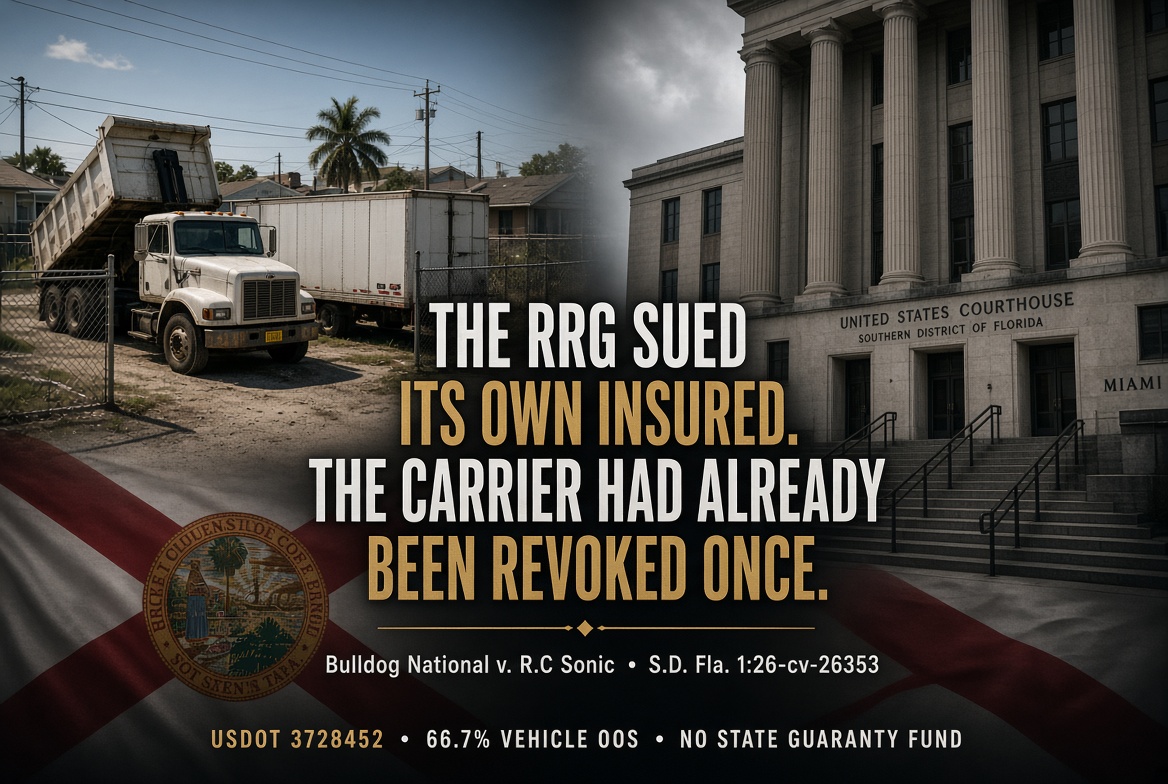
On September 15, a trucking RRG sued its own insured in federal court in Miami. The docket is routine. The carrier’s registration history is not.
On September 15, 2026, Bulldog National Risk Retention Group, Inc. filed a declaratory judgment action in the U.S. District Court for the Southern District of Florida, docket 1:26-cv-26353, assigned to Judge Melissa Damian. The defendants are R.C Sonic Trucking LLC, Brandon K. Williams, and Reynaldo Ordonez, Jr. The cause of action is 28 U.S.C. § 2201 declaratory judgment, insurance. Bulldog wants a court to define what it owes, and to whom, and under what conditions.
RRGs that cover small trucking carriers regularly go to federal court for coverage declarations. What makes this one worth a closer look is what the federal registration record shows about R.C Sonic and what that record says about the market segment Bulldog operates in.
According to FMCSA registration and licensing records, R.C Sonic Trucking LLC holds USDOT number 3728452 and MC-1315180. It’s an Orlando, Florida-based interstate motor carrier operating two power units: a dump truck and a dry van. Its common carrier authority is currently active. The insurance on file with FMCSA as of the most recent public data is $750,000 in liability coverage, filed by Professional Transportation RRG Inc., not Bulldog. That’s the first thing to hold. Bulldog is litigating coverage for a carrier whose current FMCSA insurance of record lists a different RRG entirely.
The registration history carries more weight than the current status. FMCSA records show that R.C Sonic’s authority was previously revoked and later reinstated roughly two years ago, reinstated 824 days later, with the current active period beginning January 26, 2026, according to carrier profile data from FleetFax. The Florida Division of Corporations confirms the LLC was originally filed September 1, 2021, went inactive, and was reinstated on January 21, 2026. A carrier that went dark and came back in the same calendar year it picked up a policy from a member-owned insurer is a carrier a claims department should already know well. The reinstatement gap is not a disqualifier. It’s a data point. It tells you how much history you’re pricing when you write the risk.
The out-of-service rate is the harder number. In the last 24 months, FMCSA records show three roadside inspections with a 66.7% vehicle out-of-service rate, against a national average of 22.8%. Three inspections are a small sample. A 66.7% OOS rate on that sample is not. Every vehicle that comes off the road in an inspection is a vehicle an inspector determined was too dangerous to keep moving. Two out of three is that determination, twice.
Now put Bulldog in that picture. Bulldog National Risk Retention Group was licensed in North Carolina as a risk retention group on July 2, 2018, originally under the name American Transportation Group Insurance Risk Retention Group, according to A.M. Best records. It changed its name to Bulldog National on July 1, 2022. Its stated mission, per its website, is to provide coverage for small independent trucking companies and owner-operators, up to $1 million per occurrence. That’s the segment. Small carriers, limited fleets, competitive premiums.
An RRG is not a traditional insurer. It’s a member-owned insurance company authorized under the Federal Liability Risk Retention Act of 1986, 15 U.S.C. § 3901 et seq. The members pool their liability exposure and, collectively, are both the policyholders and the owners of the entity that pays their claims. The RRG collects the premiums, holds the reserves, and writes the checks. By federal statute, it doesn’t have access to state insurance guaranty funds. Under 15 U.S.C. § 3902(a)(2), if an RRG goes insolvent, there is no state backstop for crash victims waiting on a judgment. The premium is cheaper. The protection behind it is thinner.
Weiss Ratings has flagged Bulldog’s financials as a concern independent of this litigation. The rating agency identified poor long-term capitalization and a history of deficient reserves in four of the last five years, with reserve development running between 36.7% and 204.8% deficient in that window. Operating losses ran through most of those years, though Weiss noted profits turned positive in the first half of 2025. The RRG’s North Carolina charter requires it to maintain $1,250,000 in capital and surplus. That’s the floor, not the cushion.
A declaratory judgment action filed by an insurer against its own insured is the insurer asking a court to decide whether the policy covers what happened. It’s not an admission that coverage exists. It’s not a denial that coverage exists. It’s a formal request to have a judge draw the line. The mechanism under 28 U.S.C. § 2201 lets a party seek that declaration without waiting to be sued first. Bulldog filed first. That means Bulldog wants to establish a position before someone else establishes it for them.
The complaint alleges a specific event, but the claim, exclusion, or condition Bulldog is relying on isn’t in the public docket yet. The pattern in similar RRG coverage disputes in this circuit suggests the most common grounds are a vehicle not listed on the policy schedule, a lapse in coverage tied to a reinstatement gap, or a policy condition the carrier didn’t satisfy. Any of those three would fit the known facts here. None of them has been confirmed for this case.
What the record does establish is this: a small Florida carrier with a revocation history, an active period of less than nine months at the time of filing, and a vehicle out-of-service rate three times the national average was covered or allegedly covered by a member-owned insurer with documented reserve deficiencies, no state guaranty fund backstop, and now a federal court filing that says the coverage question isn’t settled. That combination is the exposure map for everyone downstream. Brokers who tendered loads to R.C Sonic during the policy period, shippers who moved freight on those two power units, and anyone holding a judgment or a pending claim against the carrier all have an interest in how Judge Damian rules.

Leave a Reply